
View product details
Silicone Surfactants VS Non-silicone Ones

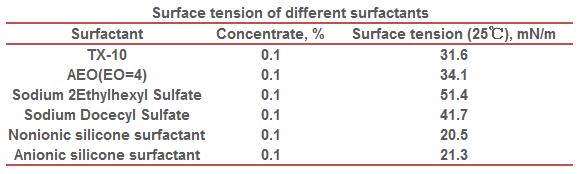
Surface tension:

Graph showing surface tension comparison between silicone and non-silicone surfactants, highlighting lower surface tension of silicone for better leaf wetting

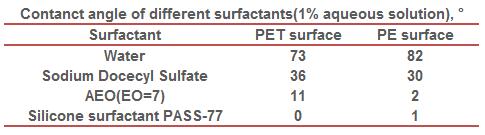
The surface tension of silicone surfactant is much lower than the non-silicone ones, and this will lead to the big gap in the contact angle,generally positively related, see table as below. 

Contact Angle:

Graph illustrating contact angle differences of silicone vs non-silicone surfactants, demonstrating improved wetting and spreading with silicon

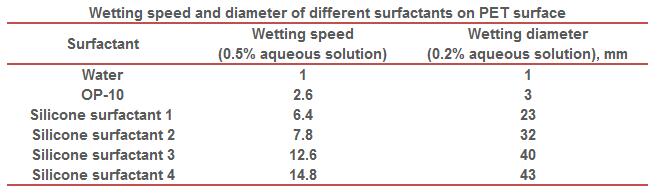
Usually the contact angle is negatively related to the wetting speed and coverage diameter on the surface, see table as below. 

Wetting speed and diameter: 

Diagram of wetting speed and droplet coverage on PET surface (hydrophobic), showing how silicone surfactants enhance leaf surface coverage and pesticide penetration

PET is a hydrophobic surface.The good performance of silicone surfactant on such surface make it possible to have good market in agriculture. 

The waxy layer of crop leaves are also hydrophobic. Genrally agrochemicals will find it hard to enter inside the leaf structure by stomatal absorption. And the wetting speed is slow, the spreading coverage is not big. The drops may slide off the leaf surface or big drop may even bounce out, thus leads to the pesticide waste and efficacy not meet the expectation. 

With the help of silicone surfactant, the agrochemicals can spread on the leaf surface, then go into the small part of crops and weeds, and maximize the efficacy. 

For discussion, contact me as below:

agricultural organosilicone supplier China profirst

CONTACT US
SHANGHAI PROFIRST CO., LTD.
Office: Room 805, No. 30, Lane 2419, Hunan Road, Pudong New Area, Shanghai 201204, China
Research Center: No. 2, Lane 1123, Kangqiao Road, Pudong New Area, Shanghai 201315 , China
TEL: +86-21-38122007
FAX: +86-21-38122006
EMAIL: info@profirst.cn
CONNECT WITH US
沪ICP备10200502号-4